


You finally took the step to apply for benefits, only to receive a denial letter.
You may be wondering: Did I do something wrong? Was my condition not serious enough? What now?
If you’re asking why your Social Security Disability claim was denied, you’re not alone. Many claims are turned down at the first stage, often due to technicalities or missing documentation — not because your condition isn’t real.
In this post, we’ll walk through some of the most common reasons people are denied and what you can do next if it happens to you.
1. Incomplete or Inconsistent Medical Evidence
Social Security needs solid, consistent medical records to understand the full impact of your condition. If your file is missing important documents, like imaging results, provider notes, or lab work, it becomes much harder for a claims examiner to fully evaluate your case.
Sometimes, people are denied because:
- Their medical records only list diagnoses without explaining limitations.
- There are gaps in care or treatment history.
- They haven’t seen a specialist when one might be expected.
- Important test results or clinical notes are missing.
Imagine trying to solve a puzzle with missing pieces.That’s what a disability examiner faces without complete documentation.
What You Can Do:
- Keep your appointments as consistently as possible
- Ask your provider to include notes about how your symptoms affect your ability to work
- Maintain a simple symptom journal to share with your doctor
- If you can’t afford regular care, explore local options like:
- North Carolina Association of Free & Charitable Clinics – www.ncafcc.org
- Federally Qualified Health Centers (FQHCs) or local health departments
- NC MedAssist – www.medassist.org
It’s not just about proving that you have a condition, it’s about showing how it affects your ability to work. Clear, ongoing medical records can make all the difference.

2. Your Condition Doesn’t Meet the SSA’s Definition of “Disability”
Even if you feel completely unable to work, the SSA uses a very specific legal definition of disability, and it’s not always intuitive.
To qualify, your condition must:
- Prevent you from doing any substantial gainful activity (SGA) — not just your most recent job.
- Be expected to last at least 12 months or result in death.
- Be severe enough to interfere with basic work-related tasks (sitting, standing, remembering, communicating, etc.)
This means someone who can work a simpler or less demanding job, even if it’s not ideal or similar to their past work, might not meet SSA’s definition.
What You Can Do:
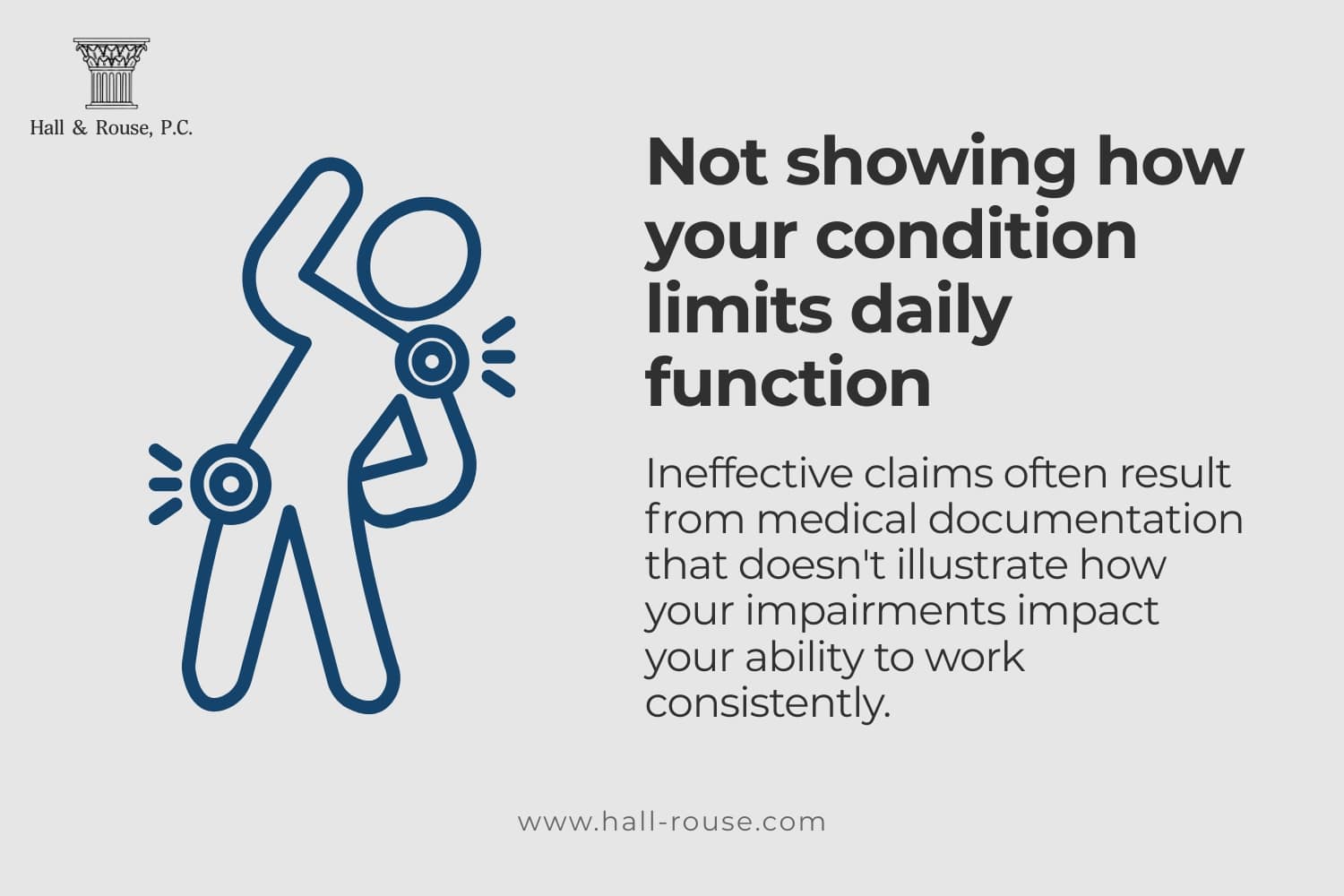
- Focus on how your condition limits you functionally — not just the name of the diagnosis.
- Keep track of symptoms, side effects, and how often they interfere with daily routines.
- Talk to your doctor about documenting not just your medical condition, but how it impacts your ability to work.
It’s frustrating, but true: how your condition affects your functioning is just as important (often more) than the condition itself.
3. You Didn’t Fill Out the Forms Completely (or Accurately)
Social Security’s forms can feel endless, but skipping questions, giving vague answers, or leaving out important details can seriously hurt your case.
SSA uses your forms, especially the Adult Function Report (Form SSA-3373) and Work History Report (Form SSA-3369), to understand your daily limitations and whether you could still do any kind of job.
Common Mistakes:
- Leaving sections blank or saying “N/A” without explanation
- Minimizing symptoms (“I get tired sometimes”)
- Listing job duties vaguely (“helped customers,” “did paperwork”)
- Not explaining how long tasks take or what help you need
SSA can misinterpret missing or unclear information as a sign that your condition isn’t that serious, even if that’s not true.
What You Can Do:
- Take your time when filling out forms, don’t rush.
- Be specific: explain how long tasks take, what causes difficulty, and how your routine has changed.
- Keep a journal for a few days to track your symptoms and limitations — it’ll help you answer questions more honestly and clearly.
- If possible, ask a trusted friend or lawyer to review your answers before submitting.
Your answers matter. They help tell your full story. Make sure they’re telling it clearly.
Denied Doesn’t Mean Defeated
Getting denied after your first Social Security Disability application feels frustrating, but it’s incredibly common, and it doesn’t mean your case is hopeless.
Now you know some of the most common reasons people are denied:
- Incomplete or inconsistent medical records that don’t clearly show how your condition affects your ability to work
- SSA determined your condition doesn’t meet their strict definition of disability
- Application forms that are vague, inconsistent, or missing important details
If your claim was denied, don’t give up. The appeals process exists for a reason, and many people are ultimately approved after fighting for their case with the right support.
Need help figuring out why your Social Security Disability claim was denied?
Let our experienced disability attorneys review your denial letter and case details. We’ll help you understand what may have gone wrong, and what steps you can take next to improve your chances.
Contact Hall & Rouse, P.C. for a free consultation. We’re here to guide you through the appeal process and fight for the benefits you deserve.